Sunday, October 30, 2011

The Critical Minutes

When there is the sun, it is always bright outside than inside a building unless of course an artificial lighting is introduced.  And artificial lighting will usually be or never be brighter than the sun. Then it strikes my mind, since day turned into night and night tuned into day, there must be that time of the day where the deep colour of dawn or dusk matches the exposure of the inside of a lighted building.

In most cases of my point and shoot photography, time of day was never an issue.  It is what I saw, I like and then I shoot. This time it is all about time and planning.  I woke up early well before 5.00am, after my solat subuh, I drove like crazy to my desired location, a mosque about 10km from home. Why a mosque? Well, it's about the only building with lighted interior at this time. I reached there, stopped by the road side at exactly 5.20am. and took this shot spot-metering the lighted interior.


Still got a bit of blue sky and lighted interior, but this picture it was taken from the roadside.  A few minutes earlier would have been a dark blue sky.  I need to go over the fence and take the shot without the fence blocking the lower part of the building. But there was a drain and I need to go to the main entrance and walk back to the same angle of view which requires me to drive and park the car and walk a hundred metres or so.


While I got to the desired spot it was already too bright and lost much of the blue spectrum. Increasing the exposure to match the interior would over-exposed the sky. Took several shot but I managed to capture the birds in flight when I was just about to pack.
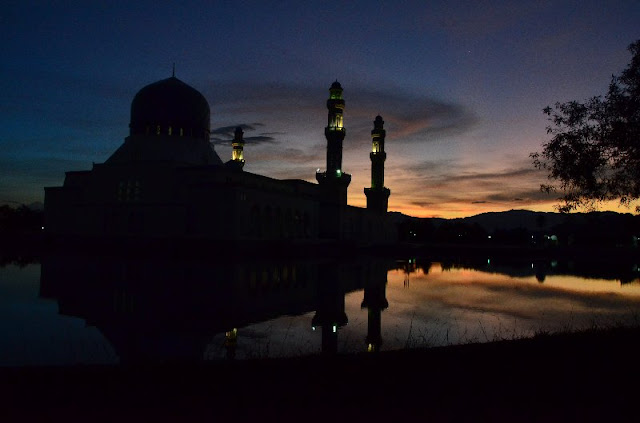


I had another underexposed shot to capture the orange spectrum but in the process loses the details of the mosque lighted interior.
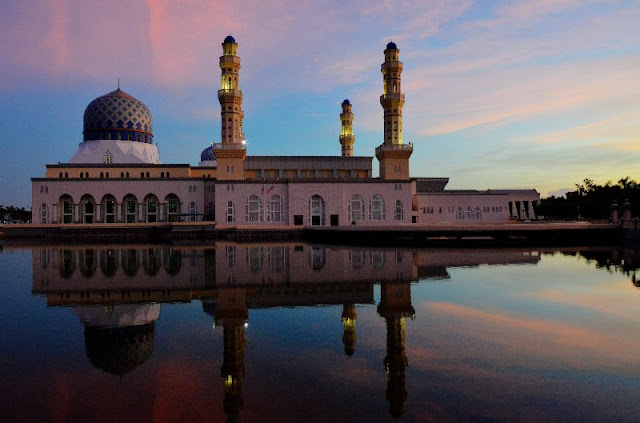


All in all, the window of opportunity was less than 10 minutes for right exposure I was looking for. It was getting brighter by the minute and as I walked back towards the car it was already too bright but I had this surreal shot of a floating mosque.

After I got home and upon reviewing the photos, I realised I made one BIG mistake!.  I had the ASA set to 800!.  After all the rush, dragging my tripod and remote trigger I ended with a grainy photos ..


Sunday, October 23, 2011

Trying out a Cheap Lens

I bought this Opteka 500mm f8 mirror lens from a local guy selling camera accessories online.  It was just a curiosity rather than a need.  It was not an easy lens to use.  For a 500mm without any kind of stabiliser forget about hand held shots. A camera stand and a remote release is a must for this lens.  This pictures was taken from the Kinabalu Golf Club in Tanjung Aru, Kota Kinabalu Sabah.


Despite using a tripod, this is not a sharp lens and contrasts a bit low.


At maximum infinity focus is a blurry and you need to turn back the focusing ring back a bit to get the focusing right.


Contrast is on the low side and appears hazy.


Depth of field is shallow and the out of focus foreground has weird out of focus effect of the mirror lens.


This is a very light lens and easy to carry around.  It is only slightly bigger than a 18-105mm Nikon but it is much much lighter.  However the lightness and a f8 maximum aperture means I still need to carry the extra weight of a tripod.

The focusing turn is very limited and very difficult to focus.  You need a super sensitive fingers to rotate the barrel in minute fraction at a time. Forget about action shots on this lens.

My opinion; don't be an idiot (like I have been) wasting good money with this lens.  It is too soft and lacks details.  It is simply not worth the RM500.00 I paid for it.  I had a better result cropping the picture with my old plasticky Nikon AF75-240mm f4.5-5.6D lens.  If  I really need a long lens, my 300mm zoom lens (on my DX will translates to 460mm), which is almost 500mm has superior optics.


Saturday, October 15, 2011

Pulau Mabul Escapade

I was waiting for my flight to Tawau when I bumped into Datuk Douglas. He was taking an earlier flight to Tawau while I was going to the same destination but via Sandakan. It was through his kind gesture that he invited me over to his Sipadan Dive Resort in Mabul, Semporna and to spend some time fishing. As usual, it was an opportunity for photogrphy for me. As I was nor prepared for a Island trip I had with me my Nikon and a standard zoom lens. If only I had broght the polariser..


Friday, October 14, 2011

Aerial View of Mout Kinabalu

It was my usual monthly trip to Tawau to my Plantation.  However this time I purposely took the indirect flight from Kota Kinabalu to Tawau with a stopover in Sandakan at 7.00 am,  I know the flight to Sandakan will fly past by the Mount Kinabalu and hopefully the sky will be clear for the intended shot.  I checked in online the night before and chose a seat 2nd row from the rear to avoid seating next to the wings.  From the ground it appeared to be misty but as the aircraft reaches above 5000 feet the sky was clear. Twenty minutes later I started taking th shots of the mountain.


It was still dark and a distance away when I took the first shot of the mountain.  I didnt really know what to expect due to the unfavourable view of the mountain from the ground.


As the aircraft climbed the view becomes clearer with spots of cloud.  This was the view with the populated main road from Kota Kinabalu can be easily seen.


The mountain as seen from the southern face while moving towards the eastern face.


View from the eastern face of the mountain.  The town of Kundasang is clearly visible at the centre of the picture.  The clear white dot is the Perkasa Hotel.


The center of the picture is the Kundasang Golf Course.


These pictures were taken using Nikon D7000 and 18-105mm Nikor.  The picture is not sharp despite taking at high speed to avoid shake and f8 aperture. I think this was due to the concave window shape of the turbo prop aircraft which adds distortion to the zoom lens.  I presume using a wide angle prime lens with polariser filter would get me a better details and contrast.  

Sunday, April 24, 2011

Mount Kinabalu Sunrise

This picture was taken at dawn before and after sunrise just several hundred meters from my house.  I was testing the dynamic range of my 2 weeks old Nikon D7000 which I bought for my birthday.

Early dawn before the sunrise.

The dynamic range was well controlled with the gradual hues of the mountain well defined 
at the same time not overexposing the lit up skies.

When the sun peeks from behind the mountain, the bright light reduces the contrasts of the shadows
but it's still visble. My older D70 would just create a black silhuette of the mountain.

A tricky shot with the camera facing the sun, the green of the grass is captured instead of just plain silhouettes.

Sunday, June 6, 2010

My Camera Progression

Photography has always been my hobby since I bought my first Halina 127 camera back in 1972.  This was a mail order from a newspaper cutting which cost me RM19.00.  It was 100% plastic including it's lens with the exception of a few springs and screws.  This was a medium format camera and therefore not a pocket camera. I have to hang it around my neck wherever I went with it.


My second camera was a Kodak Instamatic.  It was my first 35mm camera and this camera can fit in my pocket. This time the shutter button is metal and had a glass lens. To me this is a big improvement or upgrade.   The negative film came in a plastic cassette.  Just drop it in, turn the knob anticlockwise until it stop and its ready to shoot. Both of first two camera bodies were plastics.


My first metal camera was a Minolta Hi-Matic 7s rangefinder camera in 1976. This was my Dad's camera and I "borrowed" it from him - he never actually said yes when I wanted to  borrow it. Of course I used it more than him and it sort of became mine..  It was the most beautifully designed camera anyone could have.  It has a manual shutter speed selection and an aperture ring, and the exposure meter's actual EV-value displayed in the viewfinder.  But most of the time,  my exposures were merely estimates based on the guide provided in the ASA 100 film box.  Set the speed to 125, bright sunlight f16, cloudy skies f11, In the shade f8 and low light f5.6 and below.


When I started my first job in 1981, I bought a Minolta XD7 with my first salary.  It costs me RM840 at that time. This was a very good camera as it was the World’s first 35mm SLR camera with multiple exposure modes.. The shutter was silky smooth while the Nikons were still clacking away very loudly followed by sound of springs reverberating after every shot. Minoltas were producing fine electronic instruments while Nikons were producing tough work horses and could operate without batteries. I guess that's the reason why professional love the Nikon..


The XD-7 offered Aperture Priority, Shutter Priority and Manual. Since Minolta lenses were not fitted with an auto diaphragm mechanism capable to moving to a preset aperture, Minolta added an index lug and later on a minimum aperture lock to the MC lens design, this system was later copied by other brands.  Technology had evolved cameras into auto-focus and motorised zoom and Cameras had started to turn plastic again.

The subsequent Minolta XG series and Maxxums were constructed of polycarbonate bodies and I was not impressed with it. I continued using my XD7 for more than 10 years until the metering broke along with all the auto modes.


I bought my Minolta 5xi in 1993 with a 35-80mm slow f4 zoom lens. It was more of a functional camera rather than a creative tool.  I considered it to be one of the ugliest camera designed by Minolta. I lost my creative interest in photography thanks to Minolta's uninspiring product. I use the camera for my wedding shots, baby's photo and travels during the early part of my married life.  The camera works very well but the rubber grip surface became sticky and later hardens and began cracking and falling off in pieces.  That was the turning point.


I was a proud Minolta fan. It used to be a very innovative brand which manufactures better performing lens than Nikon,  Minolta  pioneered TTL metering and multi-exposure shooting modes.  Somehow it seems to lost it's direction in technological advances started to produce cameras with fanciful Buck Rogers-like designs and sadly Minolta seems to fall in love with plastics!.  That was when I started to look at at alternative make.

My first Nikon was a F60 which came bundled with two Nikkor AF zoom lens 35-70mm and a 75-240mm.  It was another plastic camera but with a more functional design. Their mechanical and electronics has improved so much and they remained as the professional choice for their toughness and durability especially the higher end F3's, F4's and F5's models.


I began eying digital Photography in the late 90's.  My first digital camera was the Canon Powershot Pro S70 bought in 1999. It costs a bomb at that time at more than RM4,200+.  It came with a 8MB.  It was power hungry and had delayed shutter response.  Press shutter.. wait about a second to hear some kind of spring releasing inside, click.. await another second or so for the picture to be saved,..  It kinda tiring... The biggest CF memory card available would be 256K and costs several hundred more. Carrying this camera around means bringing along chargers and the period's heavy and slow to power-on notebook computer.  It's just too much hassle and waiting.  The only concession of owning this camera was that I don't need to send any film for processing to view the picture.  On the other hand it will take a week to send the pictures to Kuala Lumpur to be processed and printed.  Digital photography was at it's infancy and no local processing facility available. Sad to say though most of my baby's photos taken with camera was lost due unrecoverable hard disk's crash. (I rather not be reminded about it)


The next camera was a tiny pocket camera, a Canon Digital Ixus bought in 2001. I was carrying a Yashica pocket film camera which was a free gift for something I enrolled or purchased.. can't remember what it was. I was at the Kuala Lumpur International Airport about to board a flight to Phuket, Thailand when I saw this  digital camera  at the camera shop at the international lounge. It was the very first of the Canon Ixus series.  This camera was tiny with tinier a LCD screen. It was good for traveling but would only shoot about 20+ frames on full charge NiCad batteries and camera would be hot after a few shots.

An Olympus Camedia pocket camera was purchased in a hurry in 2004 two days before my trip to Munich, Germany. This trip includes a 3 week planned self-drive vacation to Austria, Switzerland, Italy and Netherland.  So a camera was a must have. This camera produced good pictures with acceptable shutter response delay.   I had thousands of pictures taken with this camera. It was through this camera that I was impressed with the advances made in digital photography which led my interests back to SLR cameras.


The Nikon DSLR D70 was introduced later that year but I cannot afford it due to my job relocation to Kuala Lumpur, which was an expensive endeavour for a few years as I was maintaining 2 homes. I was seriously considering a Nikon because I already had two Nikkor AF zoom lens. I finally got hold of a Nikon D70 in 2006.


Realising the inconvenient bulk of my Nikon D70 during my 3 weeks biking trip in Mindanao and Cebu in the Phillipines, I bought the small Olympus E420 in 2008 which was intended for my future travels. It was the smallest DSLR available in the market.


The E420 has a lot of limitations and unfamiliar adjustments. Dark subject was difficult to focus despite triggering the flash burst to lit up the subject for focusing not to mention the irritation to both the the subject and photographer. Taking shots with the built in flash is results in horribly under-exposed pictures. I wonder if it was a defective design for the model or a just defective unit. My older Olympus Camedia would take better exposed shots with it's built-in flash. This camera however produced excellent result for daylight photography. Low light photography at ISO 400 and above tends to produce grainy pictures.

And finally the Nikon D7000 in 2011 with all the bell and whistles..


Wednesday, December 12, 2007

The Mindanao Ride

This was a Mindanao Ride for Peace IV organised by several Motorcycle club of the Phillipines inviting participants from Malaysia and the neighbouring regions. I was a participant from Malaysia from the Thunder Riders of Penampang Club. I brough along my Nikon D70 DSLR with a 18-70mm lens and took more than 1500 photos mostly of events. Apart from that I got some nice local scenes.  As I was riding motorcycle, I had to carry very limited items.


It was getting dark waiting to sail off from the port of Ozamis for Cebu when I captured these two boys fishing on a canoe alongside the ship. Taken at 57mm f 4.2 1/60 with exp bias -0.5 step.
Early in the morning as we reached the port of Cebu, the sea gypsies were swarming the ship.  I captured the mother and child begging for coins. She use the white sheet to catch the coins thrown by the passengers. The vignetting is obvious with the lens wide open. 


...while the men dived for any coins thrown into the water.

I saw this dried up fish on the floor of the ferry to Bohol Island

Public transportation in Bohol Island.

Menacing storm as we sail across from Cota Bato to Zamboanga
 
The people of Tubigon, Bohol Island


The largest building in Tubigon, Bohol Island.

 Crossing the calmest sea I have ever experienced while on the deck of the Ferry to Cebu from Bohol Island.